
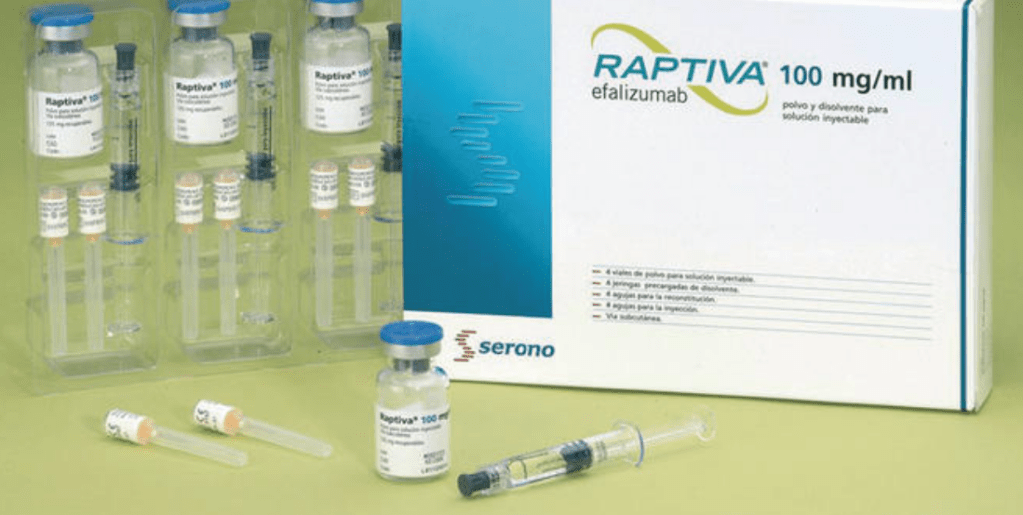
There are many drugs being marketed today to help treat disease. One of these drugs is called Raptiva, and it is used to treat psoriasis. According to Mednet antibodies are proteins produced by the body’s immune system in response to antigens, which are harmful substances. In more basic terms, the body’s immune system creates proteins when we are infected by a bacteria or virus that can help our body fight off this infection. Antigens can be more than bacteria or viruses, they can also include fungi and parasites such as worms.
Due to modern technology, scientists are able to produce antibodies like the ones naturally made in our body in a lab. These synthetic antibodies are used in many scenarios. One scenario is when the man-made antibodies are synthesized from cloned immune cells, and the monoclonal antibody that is made binds to one kind of antigen. Researchers can design antibodies that are specific to an a target antigen. They can make many copies of these, which are known as monoclonal antibodies of MABS.
According to Cancer.org, there are four ways that mabs can be made. These include murine, chimeric, humanized and human. Murin mabs are made from mouse proteins and the names of the treatments end in -omad, Chimeric mabs are made from a combination of part mouse and part human proteins and the names of the treatments end in -ximab. Humanized mabs are made from small parts of mouse proteins attached to human proteins and the names of the treatments end in-zuamb. Human mabs are fully human proteins and the names of the treatments end in -umab.
An example of a drug on the market is Efalizumab (Raptiva). It is used for the treatment of psoriasis. Psoriasis according to WebMD is a skin disorder that causes skin cells to multiply at higher rates than normal. This can lead to the skin being bumpy, red, and have patches covered with white scales. The increased production of skin cells is thought to be associated with the immune system, specifically lymphocytes. Lymphocytes are activated by adhering to other cells through their receptors on the surface of the cell. Efalizumab blocks one of these receptors on the lymphocyte, preventing it from adhering and thereby preventing the activations of lymphocytes responsible for psoriasis.
Raptiva has many side effects, it increases the risk of profressive multifocal leukoencephalophathy (PML) and risk of serious infections. PML is a progressive viral infection of the CNS that had no known treatment and can lead to death and severe disability. It also increases the risk for infections like bacterial sepsis, viral meningitis, invasive fungal disease, and other opportunistic infections. This indicates that taking this mab can decrease the functioning of the immune system and decrease the normal microbiota, increasing the risk for opportunistic infections. According to the FDA the drug contributes to the initiation and maintenance of multiple processes, including activation of T lymphocytes, adhesion of T lymphocytes to endothelial cells and migration of T lymphocytes to sites of inflammation on psoriatic skin. The FDA also states “In psoriatic skin, ICAM-1 cell surface expression is upregulated on endothelium and keratinocytes. CD11a is also expressed on the surface of B lymphocytes, monocytes, neutrophils, natural killer cells, and other leukocytes. Therefore, the potential exists for RAPTIVA to affect the activation, adhesion, migration, and numbers of cells other than T lymphocytes”
It is a very good thing that Raptiva was pulled off the market because it made individuals very susceptible to infections. In 2009, the FDA reported that there had been 3 deaths due to PML, after which it was pulled off the marked. They did not allow new prescriptions to be filled. I feel the drug is not worth it because the risk of infection is very high and the infections that are most common are often fatal.

 Madison's Microbiology Masterpiece